Sunday, January 12, 2014

Make-do and Mend Finish

I'm starting my year off strong with a double entry for the first challenge! Going thorough my rather sparse historical wardrobe I didn't find too many things to mend, and the one thing that did need mending I had to order trim for, meaning I had to wait to fix it. Going through my wardrobe did yield an old petticoat with some potential for improvements though.

The petticoat in question was actually my entry for the second challenge of last year's HSF, UFO. The pieces were cut out nearly a year prior to that. I did not have a lot of experience back then and the petticoat came out rather clumsy. I made it way too large, practically big enough for an 1860's hoop skirt. It was all gathered onto a drawstring leaving it very bulky around the waist. I decided to remake it into something a little more useful for the new wardrobe I'm building.
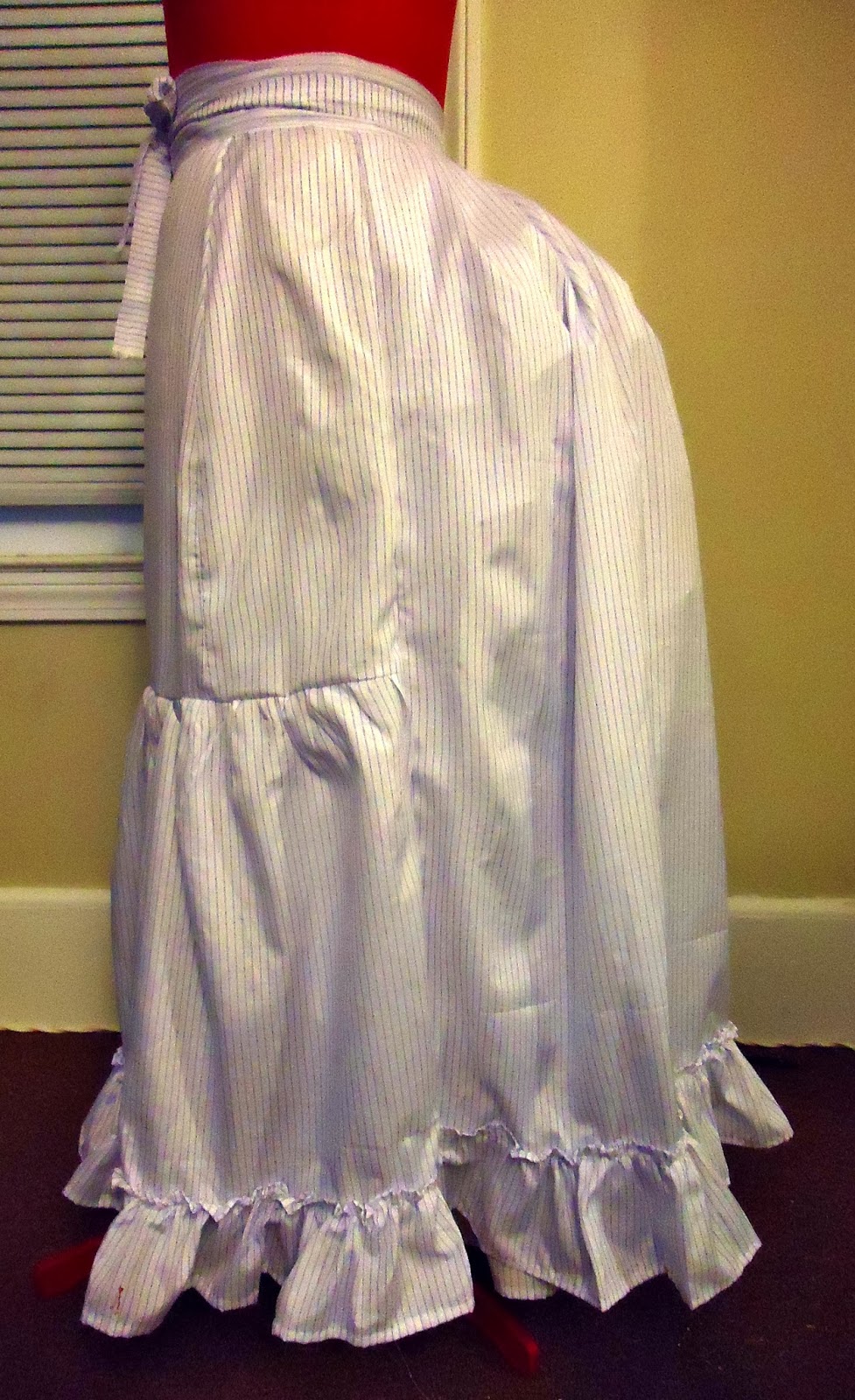

The 1860's petticoat has been updated to an 1880's petticoat! I still love this fabric, and since the old petticoat was just two very large rectangles it was pretty easy to make over. I got my inspiration from the petticoat this woman is wearing in her video. One rectangle of the old petticoat was left just as is for the back. The second rectangle was cut in half so the top could be fitted over the hips and the bottom ruffled to fill out a little more.


I was making up the pattern as I went so it didn't come out quite as smooth over the front and hips as I would have liked, but it's not really a big problem. The back piece is pleated very neatly into a nice smooth waistband. No more bulky drawstring!

Pretty little blue stripes!


I really love how the petticoat came out, and am very pleased with being able to get the correct foundations for my historical costumes made up finally! I could probably even use this petticoat for and Edwardian dress, without the bustle underneath it should have a little bit of a train.


The Challenge: #1 Make-do and Mend

Fabric: Cotton/poly blend

Pattern: None

Year: 1880's

Notions:Thread

How Historically Accurate is it? Besides the poly content of the fabric I'm calling this one mostly accurate

Hours to Complete: About 2

First Worn: Not yet

Total Cost: Nothing!

For the mend part of the challenge I focused on fixing the hemline of an antique skirt. The old wool binding on the hem was threadbare and worn. There was also a fairly large tear near the hem. The pleats hid all of the damage cosmetically but since I want to make this skirt part of my wardrobe I wanted to strengthen the hem to prevent further wear and tear.


I added a small linen patch to the largest hole in the hemline. This whole section of the hem had a lot of wear to the actual fabric itself so I bound it with a wider wool tape to protect the weakened fabric. The rest of the hemline only had damage to the wool tape used to bind it so I just patched new tape of the same width over the worst spots.


The Challenge: #1 Make-do and Mend

Fabric: Linen cloth and two types of wool tape

Pattern: None

Year: 1880's I think

Notions: Cotton thread

How Historically Accurate is it? Fairly accurate, I tried to match the original as closely as I could

Hours to Complete: 4

First Worn: Not yet

Total Cost: $18 for the wool, the rest was stash

All in all I'm excited for a strong start to the new year. I've already completed the second challenge as well, a post will be coming soon about that! I've got plans in the works to knock out almost all of the various bits of underwear I'll need for Victorian and Edwardian costumes within the first four or five challenges. Once my foundations are all made up I can focus on the gorgeous gowns to go over them!

Friday, January 3, 2014

Sewing Bunny

I know I've heard of a sewing cat many time before, but how about a sewing rabbit?

.

This is Sgt. Pepper, the cutest little nuisance in the world. Every time I lay out fabric to cut, she runs on over and plops herself down in the middle. I know she thinks it's play time when we sit on the floor, but that doesn't explain why she goes straight for the fabric. Or why she won't leave the fabric. I've been nipped at trying to shoo her away!

Perfect place for a nap

Incidentally the fabric little miss Pepper was trying to prevent me from cutting up is the start of HSF '14 challenge #2! I'm pretty proud of myself, planning this far ahead. I have a few little bits and bobs to do for the make do and mend challenge, but I'm more excited about the second challenge. I've decided to get the bustle for my planned Victorian dress out of the way.

When the challenge was announced I had a hard time coming up with an idea for it, bouncing around from one to another for a while. Then, for Christmas my mother got me a Victorian fashion book and in the first few chapters it spoke of the Crinoline and how it was one of the greatest fashion innovations of the time period.

I plan on making a "lobster tail" bustle using this tutorial from American Duchess. I know that a lobster tail bustle isn't really a crinoline, but it is a descendent of the first crinoline style. One could probably call it an innovation of it's own right, a re-styling of the old crinoline to match the fashionable silhouette of the era.

The fabric is an old cotton/poly blend that's been sitting in the stash for a while. Half of it got made into a petticoat at the beginning of last year's HSF, so it seems rather fitting that the other half get used up to kick off this year. And Pepper seems to approve of it!

Wednesday, January 1, 2014

Make Do and Mend

This year I am going to try my very hardest to finish the HSF'14 challenges ahead of time. Last year I would spend the first week of the challenge period waffling back and forth on what to do. I'd come up with a big elaborate project and then panic when I realized there was only a week left. Then I would have to come up with a new, simpler plan and by the time I had fabric and patterns and research done all that was left was a weekend to sew. Last year I pretty much depended on the weekend before the due date to get my project done since it was usually due on Monday. This year with the reorganizing of the due dates I no longer have that weekend buffer so I have to plan further ahead.

So with all of that explanation out of the way, I have my very first challenge project to introduce. About six months ago I found a gorgeous historic Victorian skirt at a vintage clothing store in my home town. The owner had been renting it out for events and was reluctant to part with it, and now that I think back on it I probably paid more than I should have for the shape it was in. It's still completely wearable though, most of the damage is just superficial.

Front

Back

I was confused at first about the unusual design with the brown top and black bottom, but I think I came up with a possible answer. If the owner was of lower class the brown fabric might have been used as a base to save on the probably more expensive black fabric. The brown base is a full skirt and the black fabric is attached on top. There was probably an overskirt or bustle that covered up the brown. The bottom decoration is gorgeous but simple, a few rows of pleating followed by two rows of flat pleats. The lack of fancier trims and a long train also lead me to believe a working class woman owned this.

Detail of the ruching

I'm not quite sure on the exact dating of this skirt. It seems to have a mixture of hand sewing and machine sewing, but that doesn't help too much since home sewing machines started being introduced in the 1860's. My best guess is that it's sometime between the 1880's and the turn of the century.

Hand stitching where the black attaches to the base

Machine stitching where the bottom ruffle attaches, the top ruffle hides this

Hand stitching on the backside of the ruching detail

This skirt is already a make-do skirt, and it definitely needs some mending. Since it was used as a rental costume it has a lot of wear and tear. The owner of the clothing store has already done a few repairs to it, but they're quick and dirty fixes in a thread that doesn't even match.

Pretty little button hole stitches

Someone seems to have ripped the button hole on the dress (a shame, look at those stitches!) and then repaired it hastily with blue thread. The mess of black thread on the top there is because they attached a hook and eye to the opening to help the weakened button hole hold. I'll probably remove the hook and eye and repair the button hole itself to be stronger.

The added hook and eye

These snaps were definitely added later

A tear also repaired with blue thread

The bottom hem of the skirt is also a raggedy mess with the original binding practically disintegrating. I will definitely be removing and replacing the bottom binding.

Ragged bottom edge

Unfortunately someone also appears to have dripped bleach onto the skirt at some point in time. I don't know how or if I could repair that. I'd be a little afraid of trying to dye the spots back, and the bleach will ultimately eat away at the fabric. It's just a few spots so I can live with it if it can't be repaired.

The worst bleach spot

More bleach damage

There are also lots of little holes, probably moth damage. I don't know if it's worth darning them all or if I should just leave them be.

Lots of little holes

One of my favorite parts of the skirt has to be the fact that it has a pocket! I always forget to put pockets in my dresses. No one really talks much about pockets when they're designing a new dress, but they are absolutely vital.

Pocket!

Now that I've thoroughly documented the skirt and all the repairs it needs, I turn to the historical community for help. There are a few repairs I know how to do on the skirt, but this is the first historical piece I've owned and I want to know the best way to preserve it. Any and all advice is welcome!

Friday, December 27, 2013

A Princess Dress for the Little Princess

My entry for HSF challenge #26 is definitely not a strict historical dress, but it's historically-inspired. My niece has been asking for a pink princess dress with long, puffy sleeves ever since I made her a Merida dress a year or two ago. She's long since outgrown the Merida dress, so Christmas was the perfect excuse to get my butt in gear working on the new dress.


Between the type of sleeves my niece wanted, a huge shortage of time and some very, very vague measurements I knew that a strict historical dress was out of the question. I decided to go with a pretty common fantasy medieval type style of dress. It's got elements of a 17th century french dress with the faux robe-over-petticoat look I gave to the front. The sleeves I'm not really sure belong to any real type of historical dress but are reminisent of the long medieval sleeves of a houppelande or such. The lacing is mostly there to help with the sizing if needed and to add a little extra detail.


Anyway the Peanut ended up loving the dress. She'll definitely get a bit more wear out of this one since there's plenty of room to grow. Still I feel a little silly entering this into the HSF but I have nothing else for the challenge and no time to make anything else, so historically-inspired it is!

The Challenge: #26 Celebrate!

Fabric: Cotton

Pattern: None

Year: None

Notions: 2 yrds lace, 2 yrds gold/purple trim, 2 yrds ribbon, eyelets

How Historically Accurate is it? Not at all

Hours to Complete: Between 3 and 4

First Worn: Christmas

Total Cost: Somewhere between $15 - $20

Monday, December 16, 2013

One Meter

Getting back on track for the Historical Sew Fortnightly! My first challenge completed on time (or at all) since wayyy back in June. I'm hoping jumping back in now will make a nice smooth transition into HSF '14. A fairly straightforward entry for the one meter challenge, I made my roommate her very first corset!


The Challenge: #25 One Meter

Fabric: Cotton Twill

Pattern: Truly Victorian 110, modified to be an underbust

Year: 1880's

Notions: 2 yrds bias tape, 22 spring steel bones, busk, 26 eyelets, 5 yrds lacing

How Historically Accurate is it? Very! The pattern is definitely accurate. It's machine sewn but that's not completely out of the realm of possibility for the 1880's.

Hours to Complete: Between 3 and 4

First Worn: To a holiday party this past weekend.

Total Cost: $12 for fabric, $11 for bones, $6 for laces and bias tape, salvaged the busk from an old corset and the eyelets came from the stash so $30 all together.


She's absolutely thrilled with the corset, and it's a pretty good fit for my first try at corseting for someone other than myself. The only issue is that it might be too big for her soon! She's planning on waist training and I was able to lace it down to a 2 inch gap the very first try. I didn't expect her to reduce 4 inches the first time! the shape of the corset is great on her too, I'm thinking of making myself an underbust from the Truly Victorian pattern too!

Saturday, December 7, 2013

Planning

I'm super excited that the Historical Sew Fortnightly is continuing into the new year. Having made it just barely halfway through the first year I'm thirsty for another shot at beating the challenge. Last year I found out about the challenge after it had already started and I jumped in with barely a second glance. This year I need a plan.

In the challenges I completed at the beginning of this year I feel like I made several pieces I was very proud of, but I didn't manage to make a full ensemble. My costume collection is fragmented and incomplete. This year I plan to flesh out the holes in my collection and end up with a full wearable wardrobe. In order to do this I want to lay out what I need ahead of time and find ways to fit them into the challenges.

Goal #1: Victorian Bustle Dress

Pieces I have:
Corset
Chemise

Pieces I need:
Petticoat
Drawers
Skirt/Overskirt
Bodice

Goal #2: Edwardian Ensemble

Pieces I have:

Skirt (an actual historical piece!)
Blousewaist (doesn't really match the skirt)

Pieces I need:

Corset
Chemise
Corset cover
Drawers
Either a skirt or blouse to match the one I have


There are already a few challenges I can fit these goals into. I really don't care too much for the color pink, at least not enough to make a full dress out of it, but some pink undergarments wouldn't bother me since I need a lot of underwear. There's also an underneath it all challenge again to help knock out the underpinnings. I believe there was a bodice challenge, so that takes care of part of the Victorian dress.

The goals above are costumes that I would get the most use of and therefore want to prioritize. The Victorian and Edwardian eras are some of my favorites and I would have the most opportunity to wear these dresses whether at conventions and events or just for fun around town.

There are other dresses and eras I really admire but don't know as much about. I don't know if I'd have any opportunities or uses for these dresses besides a one time photoshoot, but they would still be fun to make. These dresses are on my wishlist, a list I can pull from when I can't fit anything from my main goals into a challenge.

Wishlist Dress #1: Robe a la Francaise


Pieces I need:

Chemise
Corset (stays?)
Panniers
Petticoat
Robe

Wishlist Dress #2: Regency dress

Pieces I need
Chemise
Corset (corselet?)
Dress

These pieces I don't know as much about so some more research might be needed to complete my lists. Needless to say I would need all the underpinnings for these dresses, I just don't know all the terms and pieces off the top of my head. I may add to the list later, but for now this should be plenty of pieces to keep me busy for the whole year!

I'm Back!

Well, I certainly didn't mean to disappear like that, but life has a way of disrupting plans. A busy summer of commissions and a dead computer made it almost impossible to keep up with the blog or the historical sewing challenges. I've finally managed to replace the computer so I have the internet once again! How I missed you old friend. I'm not showing up empty handed either, I've got a new Historical Fortnightly Challenge entry, albeit a week late.


The Challenge: # 24 Re-do

Challenge I'm re-do-ing : #13 Lace and Lacing, #14 Eastern Influence, #19 Wood, Metal, Bone

Fabric: 1 yard of what I'm pretty sure is linen that my Uncle brought me from Japan and a yard of twill for lining

Pattern: Truly Victorian 110

Year: 1880's

Notions: 24 steel bones, busk, 26 eyelets, lacing, bias tape, thread

How Historically Accurate is it? The fabric might not be 100% but the pattern is accurate, so pretty close.

Hours to Complete:  Maybe 6 or 7

First Worn: Last Thursday

Total Cost: The fabric was a gift, the busk was salvaged from an old corset and the eyelets came from the stash so I maybe spent $20 on bones, lacing, and the fabric for the bias tape.


The fabric kind of wrinkled up on me as I was sewing the boning channels, It's a little stretchier than I thought it would be. Flat lining it with something stronger might have helped, but I was excited to try out this new pattern. I'm intending to start waist training soon so I'm looking for a comfortable corset pattern. This one I don't think is strong enough for everyday wear, but it will be a nice display piece.